

Some markets are easy to reach digitally. Others are not.
For advertisers, media agencies and data companies, one of the most interesting questions is what happens when conventional assumptions about internet connectivity no longer apply.
Can programmatic advertising reach users in one of the world’s most closed digital environments?
A ConnectX real-world test explored exactly that question. By using programmatic advertising technology to activate a campaign against North Korean inventory, the test generated measurable impressions and device-level signals — providing an unusual view into digital connectivity in a market where publicly available internet access remains extremely limited.
The result raises a broader question for the advertising industry: how much digital activity exists beyond the markets and audiences we typically consider addressable?
North Korea and the Digital Connectivity Challenge
North Korea presents a unique environment for digital connectivity.
The country’s domestic telecommunications infrastructure has expanded considerably, including mobile networks and smartphone adoption. However, access to the global internet remains highly restricted. Research published in 2026 estimates that more than 99% of the country’s population remained technically offline at the end of 2025, while cellular connections represented approximately 29.5% of the population.
This distinction is important.
A population can have widespread mobile connectivity without having unrestricted access to the open internet.
Internet Access vs. Mobile Connectivity
North Korea operates a nationwide intranet that is substantially different from the global internet. Recent analysis from 38 North notes that domestic mobile networks allow access to internal services, while international internet access remains heavily restricted.
At the same time, the country’s mobile ecosystem is developing. Research published by 38 North in 2026 identified at least 24 domestic smartphone brands and noted the expansion of 4G services introduced in 2023.
For the advertising technology industry, this creates a fascinating distinction:
Mobile connectivity does not necessarily equal conventional digital advertising reach.
Understanding that difference requires looking beyond headline internet-penetration statistics and examining actual signals from connected devices and digital environments.
The ConnectX Test: Putting Programmatic Advertising to the Test
To explore whether programmatic advertising could generate measurable activity in an extremely closed market, ConnectX conducted a real-world campaign test targeting the territory of North Korea.
The campaign used a standard programmatic advertising workflow and a display creative, with the geographic targeting configured around the country.
The objective was not to claim that the general population of North Korea is connected to the global internet.
Instead, the objective was much more specific:
Could programmatic infrastructure identify and deliver advertising impressions against reachable digital devices in a market where conventional internet-access statistics suggest extremely limited availability?
The campaign produced measurable activity.
What the Test Generated
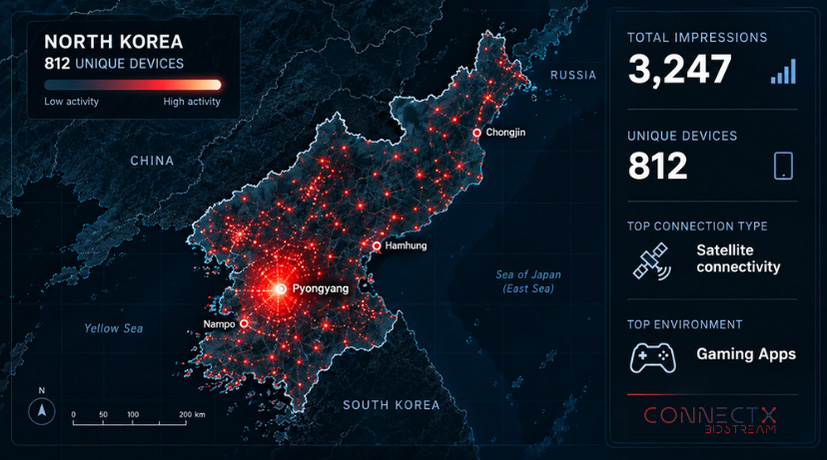
Within approximately 24 hours, the campaign generated:
- 3,247 impressions
- 812 unique devices
- Device and connection-level signals
- Geographic information associated with delivered impressions
- Device-type and environment information
These results demonstrate an important principle for modern advertising technology:
Aggregate connectivity statistics do not always tell the complete story of addressable digital inventory.
There can be a meaningful difference between the number of people who have unrestricted internet access and the number of devices that can generate observable digital advertising signals.
What the Data Revealed
The campaign data provided several interesting signals.
Device-Level Activity
The test identified 812 unique devices that generated measurable advertising activity.
This does not mean that 812 individual people were identified, nor does it imply that these devices represent the broader North Korean population.
Rather, it demonstrates that identifiable digital devices can exist within an environment that is otherwise considered extremely difficult to reach programmatically.
Geographic Signals
Programmatic advertising can generate multiple data points around an impression, including geographic information derived from available signals.
Depending on the inventory and technology stack, these signals can include:
- Latitude and longitude
- IP-related geographic information
- Device information
- Operating-system information
- Advertising identifiers where available
- Publisher or app environment
- Impression timestamps
- Connection characteristics
This type of data can help advertisers understand where digital activity is occurring, even when traditional audience research is limited.
Connection Signals
One particularly notable signal observed during the test was connectivity associated with satellite internet.
The presence of satellite-related connectivity signals is significant because satellite internet can provide connectivity independently of traditional terrestrial infrastructure.
However, a detected connection type should be treated as a data signal, not automatically as proof of a specific individual, organisation or service relationship.
That distinction is essential when working with programmatic data in unusual or low-transparency markets.
Why Programmatic Advertising Is Useful in Hard-to-Reach Markets

Programmatic advertising is fundamentally based on signals.
When an eligible impression becomes available, advertising systems can evaluate information associated with that opportunity and determine whether it matches campaign requirements.
This makes programmatic technology particularly interesting in markets where traditional media planning data is incomplete.
1. It Works With Available Signals
Programmatic platforms can evaluate signals such as:
- Location
- Device type
- Operating system
- Publisher
- App or web environment
- Context
- Advertising identifiers
- Connectivity characteristics
The availability of these signals varies by market, platform and regulatory environment.
2. It Provides Measurable Activity
Instead of relying solely on assumptions about connectivity, advertisers can examine actual campaign delivery.
Impressions, unique devices and other available event-level signals can provide evidence of observable activity.
3. It Can Reveal Unexpected Digital Environments
One of the most valuable aspects of programmatic data is that it can sometimes challenge assumptions.
A market may appear digitally inaccessible at population level while still containing specific pockets of reachable devices, applications or connected environments.
This is where data-driven advertising intelligence becomes particularly valuable.
What This Test Does — and Does Not — Prove
It is important to interpret the results carefully.
The campaign does not establish that:
- Most North Koreans have access to the global internet.
- The identified devices belong to ordinary North Korean citizens.
- Every impression represents a unique person.
- A particular satellite provider is responsible for every detected connection.
- Advertising activity represents nationwide internet penetration.
Instead, the test demonstrates something narrower and more measurable:
Programmatic advertising infrastructure was able to generate observable digital advertising activity within the geographic boundaries of North Korea.
That distinction matters.
Public research continues to show that unrestricted global internet access remains extremely limited in North Korea.
What Advertisers Can Learn From Closed Markets
The North Korea test provides lessons that extend beyond one country.
Data Can Be More Valuable Than Assumptions
Traditional market research often starts with questions such as:
How many people are online?
Programmatic technology allows another question:
What addressable digital signals can we actually observe?
Those questions are related, but they are not identical.
Connectivity Is Becoming More Complex
The global digital ecosystem increasingly includes:
- Cellular networks
- Wi-Fi
- Satellite connectivity
- Connected TV
- Mobile applications
- Digital out-of-home environments
- Alternative internet infrastructure
As connectivity becomes more diverse, media planning based on a single definition of “internet users” becomes increasingly incomplete.
Location Intelligence Adds Another Layer
Location data can help advertisers understand where impressions occur and identify patterns that would otherwise remain hidden.
When combined responsibly with device, contextual and campaign data, location intelligence can provide a more granular picture of digital activity.
The Future of Advertising Intelligence
The advertising industry is moving beyond simple questions of reach. Modern advertisers increasingly want to understand:
- Where are users?
- What devices are they using?
- What environments are they engaging with?
- What connectivity exists?
- Which signals can be observed responsibly?
This is where technologies such as programmatic advertising, location intelligence, bidstream analysis and data aggregation become increasingly important.
The goal is not simply to reach more devices.
It is to understand the digital signals behind those devices and turn fragmented information into actionable intelligence.
A More Connected World Than We Think
The North Korea experiment offers an unusual but valuable reminder: digital connectivity is not always visible from the surface.

Even in highly restricted environments, pockets of digital activity can exist.
For advertisers and data-driven organisations, the broader lesson is not about one country. It is about the importance of measuring observable signals instead of relying solely on assumptions about connectivity.
Programmatic advertising provides one way to investigate those signals at scale.
And as the global digital ecosystem becomes more fragmented and complex, the ability to identify, analyse and interpret those signals responsibly will become increasingly important.
The world may be more digitally connected than conventional statistics suggest — but understanding that connectivity requires better data, better technology and careful interpretation.
From Data Signals to Digital Intelligence
The most interesting advertising opportunities are not always found in the easiest markets. Sometimes, the most valuable insights come from asking a different question.
Instead of asking “How many people are online?”, ask:
“What digital signals can we actually observe?”
That shift — from assumptions to measurable signals — is at the heart of modern programmatic advertising and data intelligence.
For ConnectX, the North Korea test represents an example of how advertising technology can be used not only to deliver campaigns, but also to understand the changing shape of global digital connectivity.
Frequently Asked Questions (FAQs)
Can programmatic advertising reach North Korea?
A ConnectX campaign test generated measurable programmatic advertising activity within North Korea, including thousands of impressions and hundreds of unique devices. However, this should not be interpreted as evidence of widespread unrestricted internet access among the country’s population.
Does North Korea have internet access?
North Korea has limited access to the global internet, while its domestic intranet and mobile networks are much more widely used. Recent research indicates that more than 99% of the population remained technically offline from the global internet at the end of 2025.
Does North Korea have mobile networks?
Yes. North Korea has a nationwide cellular network, and recent research indicates that mobile coverage extends across a large portion of the country. The country’s mobile ecosystem has also expanded, with 4G services and numerous domestic smartphone brands.
What data can programmatic advertising provide?
Depending on the available inventory and platform, programmatic advertising can provide signals such as impressions, device information, geographic information, timestamps, application or publisher environment, and advertising identifiers where permitted and available.
Does an advertising ID identify a person?
No. An advertising identifier is generally a pseudonymous device or advertising identifier rather than a person’s real-world identity. Additional data and lawful identity-resolution processes would be required to associate digital signals with a specific individual, where legally permitted.
What is location intelligence in advertising?
Location intelligence uses geographic and spatial signals to understand where digital activity occurs. In advertising, it can help with audience analysis, geographic targeting, campaign measurement and understanding patterns of device activity.
Why is programmatic advertising useful for hard-to-reach audiences?
Programmatic advertising can evaluate real-time digital signals and available inventory rather than relying exclusively on traditional market-level audience statistics. This can make it useful for investigating fragmented or less transparent digital environments.
Does this campaign prove that North Korea has widespread internet access?
No. The campaign demonstrates observable advertising activity, not widespread unrestricted internet access. Independent research continues to indicate that global internet access remains highly restricted in North Korea.
What is the broader lesson for advertisers?
The broader lesson is that connectivity should be evaluated through multiple signals. Combining programmatic data, location intelligence, device information and contextual signals can provide a more detailed understanding of digital activity than relying on a single connectivity statistic.